Introduction
When the idea of a call-sidecar is raised, the first response is usually, "We already have chat." That makes sense on paper: chat exists, it is familiar, and it feels like the obvious answer.
Call centre clarity is not about adding a channel. The gap is mid-call precision, at the exact moment clarity matters. That is where a sidecar exists, and where chat does not.
This short demo shows how a written clarity layer can be added to a live voice call without switching channels.
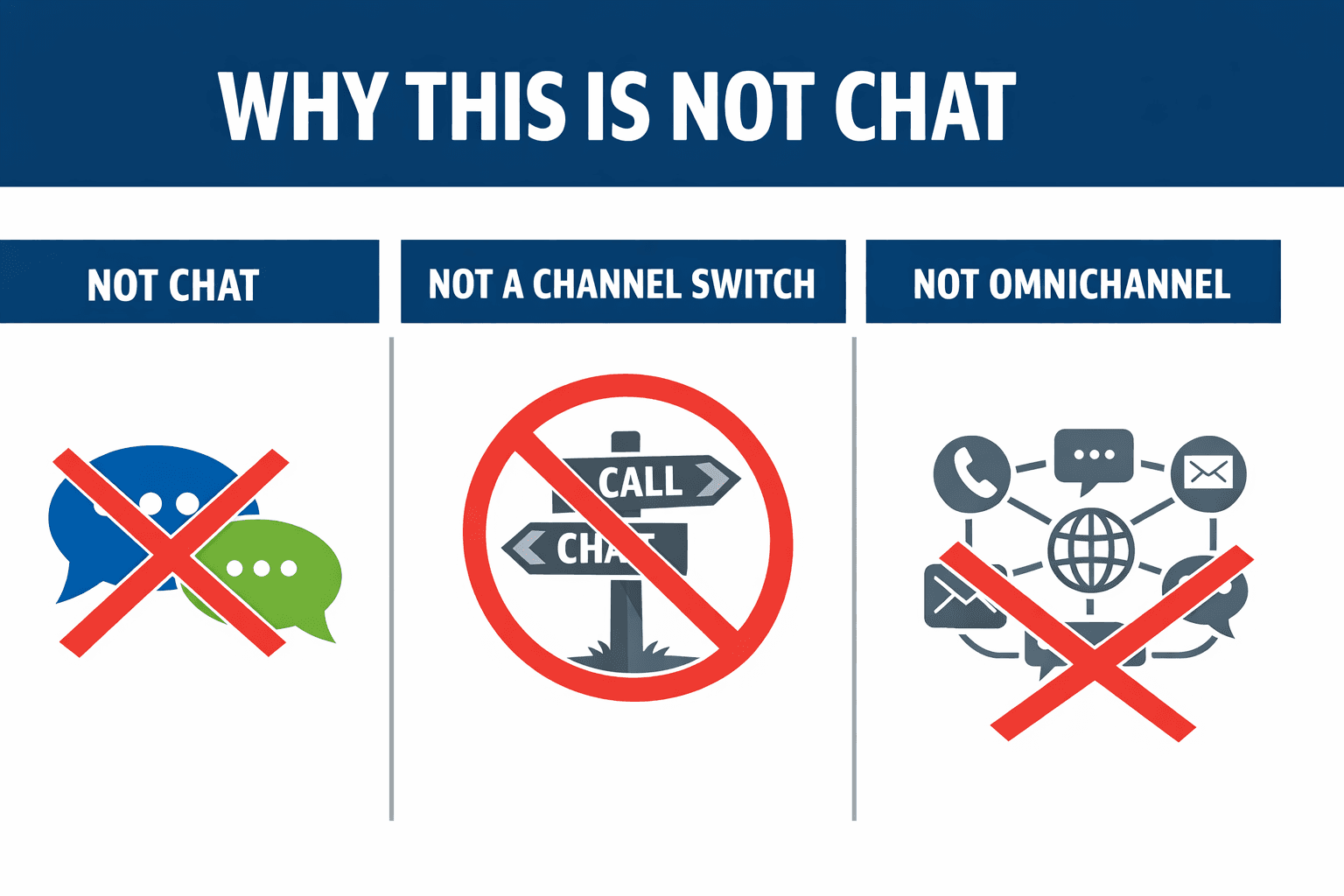
What this is not
Not chat
Chat is a channel with its own start, its own timeline, and its own expectations. It is designed for conversations that can pause, resume, and continue after the call ends. A sidecar is not that. It is a short, purpose-built layer that appears only to capture clarity while the voice call is active.
Not a channel switch
A sidecar does not move the customer away from the call. There is no handoff, no deflection, and no change in the main line of communication. The call stays central. The sidecar simply holds the small pieces that are hard to say out loud.
Not omnichannel
Omnichannel stacks are built to unify histories across SMS, email, chat, and voice. That solves a different problem: continuity across touchpoints. A sidecar solves real-time precision inside one touchpoint. It is not a "new channel" in the CRM sense. It is a live-call clarity overlay.